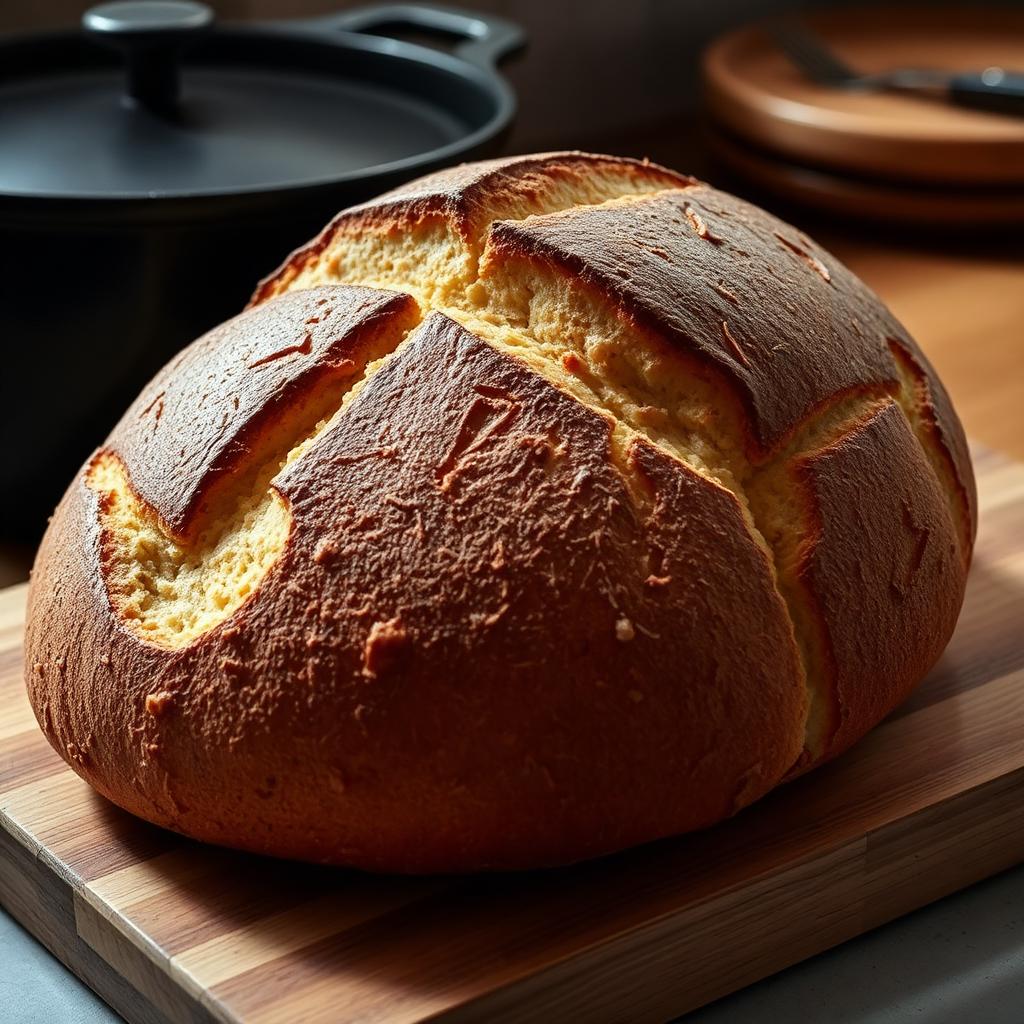
Quick Answer
Mix 500 grams of bread flour, 350 grams of warm water, 100 grams of active starter, and 10 grams of salt. Do four stretch and folds over two hours, let the dough rise at room temperature for 4 to 6 hours until almost doubled, shape it into a tight ball, refrigerate overnight, then bake in a preheated Dutch oven at 500 degrees Fahrenheit (260 Celsius) for 20 minutes covered and 20 to 25 minutes uncovered.
Total active hands on time is about 30 minutes, total clock time is roughly 24 hours including the slow fermentation that gives sourdough its flavor and open crumb.
What you need before you start
- An active sourdough starter. It should double in size within four to six hours of feeding and float when a spoonful is dropped into water.
- Bread flour. Higher protein than all purpose, which gives you a chewier crumb and more rise. King Arthur, Bob Red Mill, or any bread flour with at least 12.5 percent protein works.
- A kitchen scale. Volume measurements are unreliable for bread. A 20 dollar digital scale solves it.
- A Dutch oven. Cast iron with a tight lid, 4 to 6 quart capacity. The lid traps steam, which gives the loaf an open crumb and a glossy crust.
- A banneton or a bowl lined with a floured tea towel for the final rise.
- A razor blade or sharp paring knife for scoring.
The four ingredient recipe
| Ingredient | Weight | Baker percentage | Role |
|---|---|---|---|
| Bread flour | 500 g | 100 percent | Structure from gluten |
| Warm water (90 degrees Fahrenheit, 32 Celsius) | 350 g | 70 percent | Hydrates the flour, controls crumb |
| Active sourdough starter | 100 g | 20 percent | Wild yeast and lactobacilli for rise and tang |
| Fine sea salt | 10 g | 2 percent | Flavor and gluten strength |
70 percent hydration is the sweet spot for beginners. Higher and the dough gets sticky and hard to shape. Lower and the crumb stays tight.
The 24 hour timeline
- Morning, day 1, around 8 am. Feed your starter 1:1:1 (50 g starter, 50 g flour, 50 g water). Let it sit until it doubles, about four to six hours.
- Early afternoon, around noon. Mix the dough.
- Noon to 2 pm. Four stretch and folds, 30 minutes apart.
- 2 pm to 6 pm. Bulk fermentation. Dough should rise by about 50 to 75 percent and feel airy.
- 6 pm. Shape into a tight ball, place in a floured banneton seam side up.
- 6 pm to 7 am next day. Cold retard in the fridge.
- 7 am, day 2. Preheat Dutch oven for an hour.
- 8 am. Score and bake.
Step 1: mix the dough
- In a large bowl, whisk together 350 g warm water and 100 g active starter until milky.
- Add 500 g bread flour. Mix with a stiff spatula or your hands until no dry flour remains. The dough will be shaggy and rough.
- Cover with a damp tea towel and rest for 30 minutes (this is called the autolyse and lets the flour hydrate fully).
- Sprinkle 10 g salt across the top, add a tablespoon of water, and pinch and squeeze the dough to mix the salt in evenly.
Step 2: stretch and folds
Stretch and folds replace machine kneading. They develop gluten gently and trap air bubbles you can see later in the crumb.
- Wet one hand to keep the dough from sticking.
- Reach under one side of the dough, lift it up until it almost tears, and fold it over the top.
- Rotate the bowl 90 degrees and repeat. Do all four sides.
- Cover and rest 30 minutes.
- Repeat the four sided stretch and fold three more times, 30 minutes apart, for a total of four sets in two hours.
After the last fold the dough should feel smooth, elastic, and slightly puffy.
Step 3: bulk fermentation
Let the dough rest at room temperature, covered, for another two to four hours. Total bulk time from mixing to shaping is four to six hours in a 72 degree Fahrenheit (22 Celsius) kitchen. Warmer kitchens go faster, cooler kitchens slower.
The dough is ready when it has risen about 50 to 75 percent, looks domed, and shows small bubbles on the surface and sides of the bowl. It should jiggle when you shake the bowl.
Step 4: shape the loaf
- Lightly flour the counter and turn the dough out.
- Gently stretch it into a rough rectangle.
- Fold the top down to the middle, the bottom up over that, and the left and right sides into the middle (a basic letter fold).
- Flip seam side down and use both hands to drag the dough toward you a few times, building surface tension into a tight round.
- Flour a banneton generously (rice flour does not stick) and place the dough inside, seam side up.
Step 5: overnight cold retard
Cover the banneton with a shower cap or plastic bag and refrigerate for 12 to 16 hours. This slow cold fermentation deepens flavor, firms the dough so it scores cleanly, and lets you bake fresh bread first thing in the morning.
Step 6: bake in a Dutch oven
- One hour before baking, place an empty Dutch oven with the lid on into a cold oven and preheat to 500 degrees Fahrenheit (260 Celsius).
- When the oven is fully preheated, turn the dough out of the banneton onto a piece of parchment paper.
- Score the top with a razor blade. A single curved slash 3 to 4 millimeters deep works for beginners.
- Carefully lift the parchment and dough into the hot Dutch oven, cover with the lid.
- Bake covered for 20 minutes. The steam trapped under the lid is what gives sourdough its dramatic oven spring and shiny crust.
- Remove the lid and lower the oven to 450 degrees Fahrenheit (230 Celsius). Bake another 20 to 25 minutes until deep golden brown.
- Lift the loaf onto a cooling rack. Tap the bottom; it should sound hollow. Internal temperature should read 205 to 210 degrees Fahrenheit (96 to 99 Celsius).
- Cool at least one full hour before slicing. Cutting hot bread gives a gummy crumb.
Troubleshooting
| Problem | Likely cause | Fix |
|---|---|---|
| Dense, tight crumb | Underproofed or weak starter | Use starter at peak, extend bulk fermentation |
| Flat loaf that spread on baking | Overproofed or too high hydration | Shorter bulk, lower hydration to 65 percent |
| Pale crust | Oven not hot enough | Verify oven temp with a separate thermometer |
| Gummy interior | Sliced too early | Wait at least one hour after baking |
| Score did not open | Too shallow or dough underproofed | Score 4 to 5 mm deep at a 30 degree angle |
Storing your loaf
- First two days: cut side down on a wooden board, room temperature. The crust stays crisp.
- Days 3 to 5: wrap in a clean tea towel or paper bag.
- Longer: slice the loaf and freeze in a zip bag. Toast slices straight from the freezer.
Avoid the fridge. It stales bread faster than the freezer.
FAQs
How do I know if my starter is ready to bake with?
Drop a spoonful into a glass of water. If it floats it has enough gas to leaven bread. It should also have at least doubled and smell pleasantly tangy, like yogurt or beer.
Can I bake sourdough without a Dutch oven?
Yes. Bake on a preheated baking stone with a tray of boiling water on the rack below to create steam. The Dutch oven is easier and more consistent.
Why is my sourdough so sour, or not sour enough?
Longer cold retards and a slightly older starter create more sour flavor. Shorter bulk and a freshly fed starter give a milder, sweeter loaf.
How long does sourdough last?
True sourdough stays good at room temperature for three to five days without preservatives because the lactic acid from fermentation slows mold.
The takeaway
Active starter, four stretch and folds, a four to six hour bulk, an overnight cold rest, and 40 to 45 minutes in a screaming hot Dutch oven. Get those five things right and you will pull out a bakery quality loaf with a crackling crust and an open, tangy crumb every time.