Quick Answer
"Ancient grains" is not a strict, peer-reviewed botanical or scientific term; it is primarily a marketing category. It refers to cereal grains and pseudocereals, like quinoa, amaranth, spelt, farro, and einkorn, that have remained largely unchanged by modern selective breeding, genetic modification, and hyper-industrialized farming over the last several hundred years.
If you walk through the bread aisle, the cereal aisle, or even the snack aisle of a modern grocery store today, you will inevitably see the phrase "made with ancient grains" plastered in earthy, rustic fonts across the packaging. It carries an immediate aura of health, purity, and history. It sounds inherently better than whatever is in the standard, cheap white bread sitting on the bottom shelf.
But is an "ancient grain" actually a specific biological and botanical category, or is it just a clever, highly effective way for food companies to sell you a more expensive loaf of bread?
I study the intersection of agronomy, historical botany, and modern food marketing. Today, I am looking at the history of human agriculture to explain what an ancient grain actually is, how it fundamentally differs from the modern wheat that dominates the globe, and why returning to these older crops might actually matter for your digestive system and the health of the planet.
A definition born of marketing, grounded in reality
From a strict, pedantic botanical standpoint, all grains on earth are ancient. The modern wheat we eat today shares a direct genetic lineage with the wild, unruly grasses gathered by early human hunter-gatherers in the Fertile Crescent thousands of years ago.
The term "ancient grain" was essentially coined by the modern food marketing industry. The goal was to draw a distinct line in the sand between traditional, culturally significant crops and the hyper-industrialized modern wheat that currently dominates global agriculture. The Whole Grains Council, a non-profit consumer advocacy group, generally defines ancient grains as those crops that have been planted, grown, and harvested in the exact same way for hundreds, if not thousands, of years, without undergoing modern genetic alterations or aggressive cross-breeding.
The history of wheat and the Green Revolution
To truly understand the appeal and the rise of ancient grains, you have to look at exactly what happened to standard wheat in the 1960s.
Following World War II, the global population was exploding, and the threat of mass starvation was very real. In response, agricultural scientists, most notably Norman Borlaug, who won a Nobel Peace Prize for his work, initiated the "Green Revolution." They aggressively cross-bred traditional wheat to create new, high-yield, disease-resistant varieties.
Crucially, they introduced "dwarfing genes" into the plant. Traditional wheat grew very tall, meaning if a heavy storm rolled through, the wind would blow the stalks over, ruining the crop. The new modern wheat (Triticum aestivum) was engineered to grow short, thick, and heavy with grain. It grew faster, resisted rust diseases, and produced massive amounts of gluten.
This agricultural triumph saved millions from starvation, but it fundamentally altered the biology of the grain. The high gluten content made it perfect for industrial baking, allowing massive factories to pump out soft, highly processed, airy white bread at a global scale. However, the focus was entirely on yield and volume, not on nutritional density or human digestion.
Ancient grains, like spelt, einkorn, and emmer (farro), completely missed out on this agricultural revolution. They were left behind by industrial farmers. Because of this, they still grow tall, they yield significantly less grain per acre, and they proudly retain their original, wild genetic structure.
The gluten difference: gliadin and glutenin
One of the main reasons consumers are migrating toward ancient grains is digestion. Many people who experience bloating, lethargy, or discomfort when eating modern white bread find that they can eat sourdough made from ancient grains with zero issues.
Why? It comes down to the microscopic structure of the protein. Gluten is not a single entity; it is a matrix formed by two proteins called gliadin and glutenin. Modern wheat was specifically bred to have incredibly strong, elastic, and high-volume glutenin structures so bread dough can stretch and hold massive air bubbles without popping.
While ancient wheats like spelt, einkorn, and kamut are not gluten-free (they are highly dangerous for anyone with actual Celiac disease), their cellular gluten structure is much weaker, more fragile, and highly water-soluble compared to modern wheat. Because the protein matrix is less aggressive and hasn't been selectively bred for maximum elasticity, the human digestive tract often has a much easier time breaking it down.
A deep dive into the grains
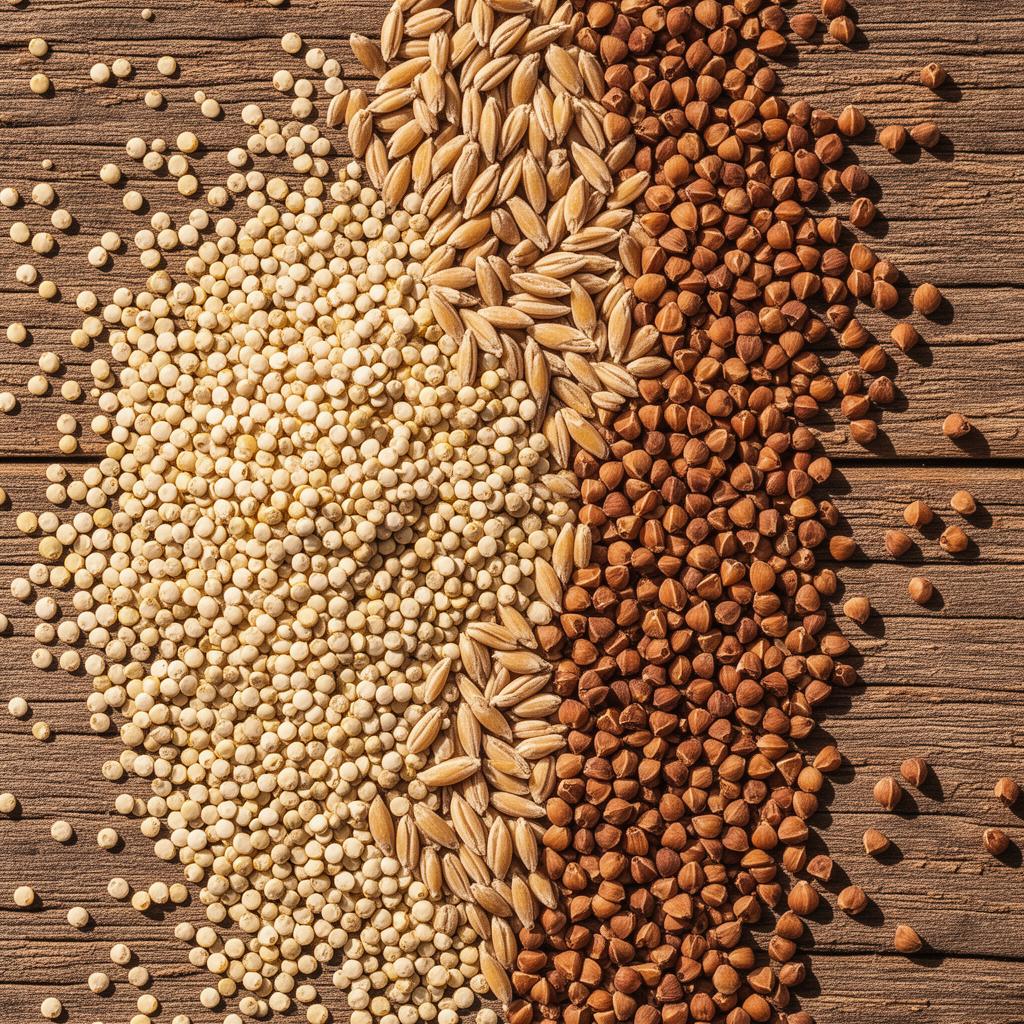
The "ancient grain" umbrella covers a wide variety of plants, which can generally be split into two categories: true wheats and pseudocereals.
The true wheats (the Triticum family)
- Einkorn: This is the grandfather of all wheat. It is the oldest known variety, possessing a simple diploid genetic structure (only 14 chromosomes, compared to modern wheat's 42). It is incredibly dense in protein and lutein (an antioxidant good for eye health).
- Emmer (farro): An ancient tetraploid wheat that formed the backbone of the diet of the Roman Legions. It has a tough hull, a chewy texture, and a rich, nutty flavor perfectly suited for heavy winter soups.
- Spelt: A highly popular hexaploid wheat that behaves very similarly to modern wheat in baking, but maintains a sweeter flavor and a more fragile gluten structure.
The pseudocereals (the seeds)
These are plants that are biologically not grasses (and therefore completely naturally gluten-free), but are cooked and consumed exactly like grains.
- Quinoa: A staple of the ancient Incan empire. It is a nutritional anomaly because it is a "complete protein," meaning it contains all nine essential amino acids the human body cannot produce on its own.
- Amaranth: A microscopic, highly resilient seed revered by the Aztecs, packed with calcium, magnesium, and iron.
- Buckwheat: Despite the confusing name, it has no relation to wheat. It is a seed related to rhubarb, heavily used in Japanese soba noodles and Eastern European kasha, known for its intense, earthy flavor and high levels of the antioxidant rutin.
The agronomic benefits of going backwards
The resurgence of ancient grains isn't just good for the human gut; it is incredibly beneficial for the environment.
Modern dwarf wheat relies heavily on synthetic chemical fertilizers and massive irrigation systems to achieve its high yields. Ancient grains, because they have retained their wild genetic traits, often feature massive, deep root systems. These deep roots allow them to scavenge for water and nutrients deep within the soil, making them naturally drought-resistant and less reliant on chemical inputs.
By creating a consumer demand for spelt, teff, and amaranth, we are encouraging farmers to diversify their fields. This biodiversity breaks disease cycles, improves soil health, and moves our agricultural system away from a dangerous reliance on a single, highly engineered crop.