Quick Answer
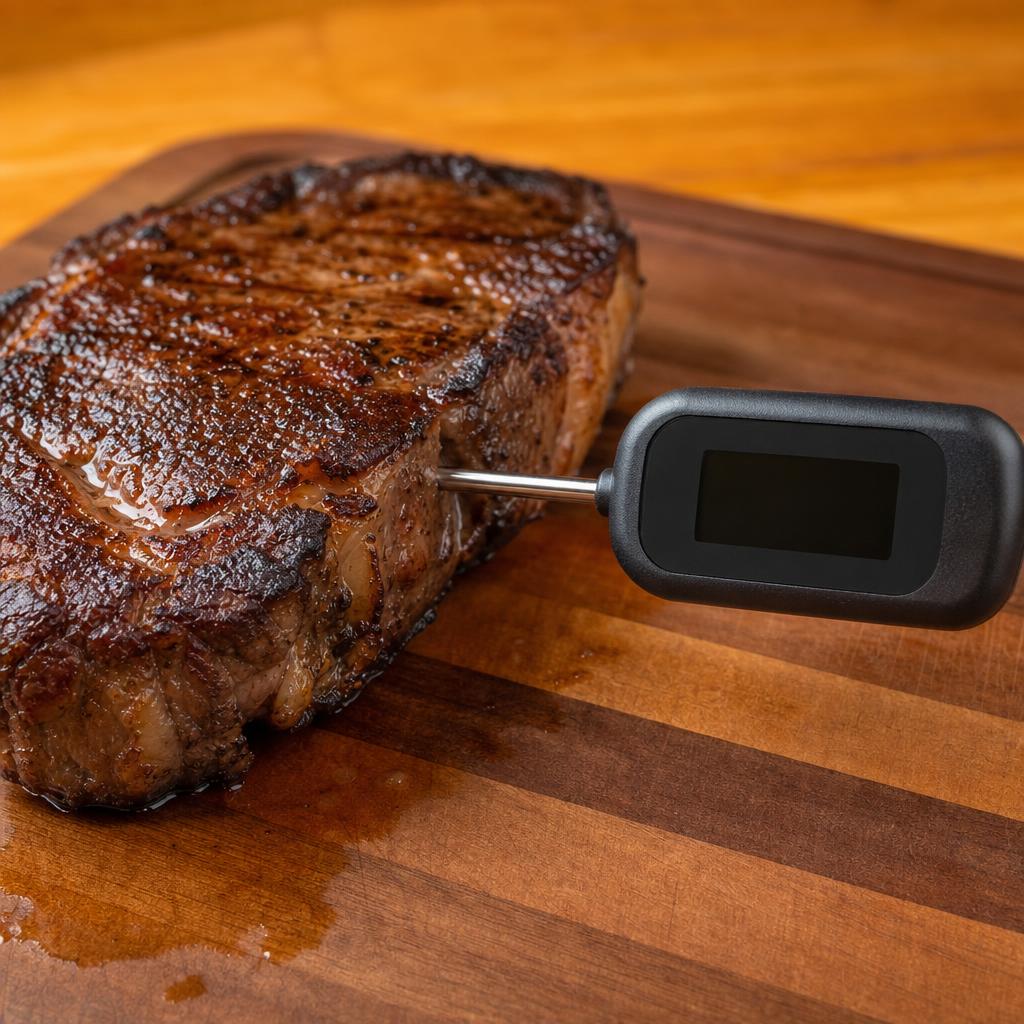
Push the metal probe into the thickest part of the muscle, away from bone and pockets of fat, until the tip sits in the dead centre of the cut. Wait a few seconds for the reading to stabilise.
Pull beef and lamb steaks at 3 to 5°C below your target because the internal temperature keeps rising as the meat rests. The USDA minimums are 63°C (145°F) for whole beef, pork, and lamb, 71°C (160°F) for ground meats, and 74°C (165°F) for all poultry.
Why a thermometer matters more than time
Cookbook timings assume a specific size, starting temperature, oven calibration, and altitude. Your oven, steak, or chicken almost never match those exact conditions. A probe takes thirty seconds and tells you the actual answer, with no guessing required.
Eyeballing doneness by cutting into the meat lets juice run out and dries the cut. Pressing it with a finger is unreliable until you have cooked thousands of steaks. A $20 digital instant-read thermometer is the cheapest cooking upgrade you can buy.
The temperatures you actually need to know
The USDA minimums for food safety:
- Whole beef, pork, lamb, veal: 63°C (145°F), then rest 3 minutes
- Ground meats (beef, pork, lamb): 71°C (160°F)
- All poultry, whole or ground: 74°C (165°F)
- Fish and shellfish: 63°C (145°F)
For steaks, professional kitchens pull at lower temperatures because flavour and texture peak below the safety minimum, and carryover does the rest. Common pull targets: 49°C rare, 54°C medium-rare, 60°C medium, 65°C medium-well, 71°C well done.
For pork, modern guidance allows pulling at 63°C with a 3-minute rest, that produces juicy meat with a faint pink centre that is completely safe.
Step one: pick the right thermometer
Two types matter for home cooking. Instant-read probes (Thermapen, ThermoPro TP19, ThermoWorks Classic) give a reading in 2 to 6 seconds and are perfect for quick spot checks. Leave-in probes with a wire that runs out of the oven let you monitor a roast or whole bird without opening the door.
Skip the old-fashioned dial-style thermometers. They take 30 seconds to settle and are usually 5 to 10 degrees off. A basic digital instant-read costs around $15 and is accurate to within a degree.
Step two: place the probe correctly
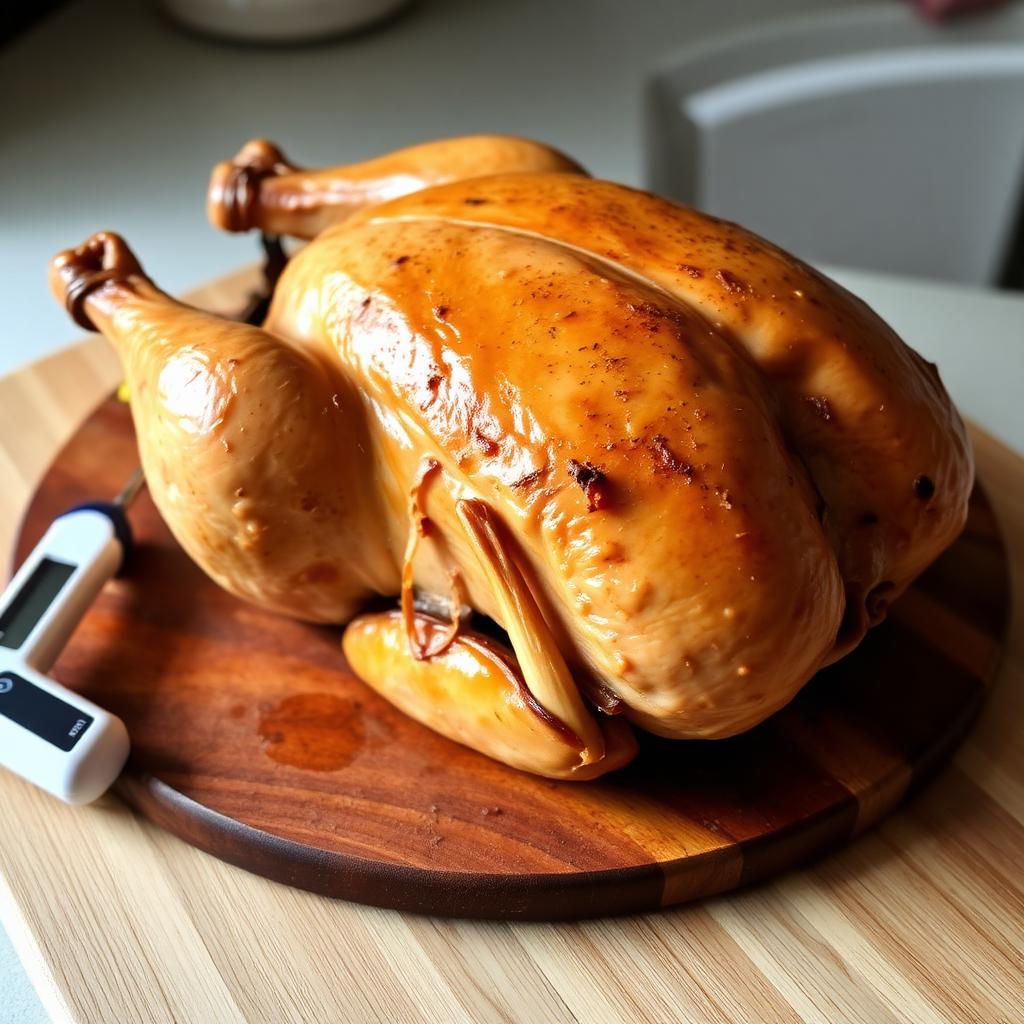
The sensor sits at the very tip of the metal needle. Whatever the tip touches is what gets measured. So the rule is simple: get the tip into the geometric centre of the thickest muscle.
- Steaks and chops: insert horizontally through the side, with the tip in the middle of the thickness.
- Whole chicken or turkey: push into the thickest part of the thigh, parallel to the bone, until the tip is right next to (but not touching) the bone.
- Roasts: from the side into the centre. Avoid the fatty cap and any bone.
- Burger patties: through the side, into the middle.
Why avoid bone? Bone conducts heat faster than muscle and will give you a falsely high reading. Why avoid fat? Pure fat heats and cools faster than meat and lies about the doneness of the surrounding muscle.
Step three: account for carryover cooking
Meat keeps cooking after you take it off the heat. The hot outer layers continue to push heat inward toward the cooler centre. For a typical steak that means a 3 to 5°C rise during the rest. A large roast can climb 8 to 10°C.
So if you want medium-rare at 54°C, pull the steak at 50°C. If you want a whole roast chicken at 74°C in the thigh, pull at about 70°C. Let it rest under loose foil for 5 minutes (steaks) or 15 to 20 minutes (roasts) before slicing. The juices redistribute and the meat hits its final target on the cutting board.
Calibrate your thermometer
Once a year, do a quick ice-water check. Fill a glass with crushed ice, top up with cold water, stir, and wait a minute. Insert the probe without touching the sides or bottom. It should read 0°C (32°F) within a degree. Most digital units have a calibration button if it is off.
Frequently asked questions
Where exactly do I check a whole turkey?
The deepest part of the thigh, with the probe angled toward the body cavity but not touching the bone. The thigh runs cooler than the breast, so when the thigh hits 74°C (165°F), the breast is already done.
Can I leave a probe in the meat the whole time?
Only if it is a heat-rated leave-in probe with a wire that runs out of the oven to a base unit. Instant-read units are not designed to sit in a hot oven and will damage their electronics. Buy a dedicated leave-in (ThermoWorks Smoke, Meater, ThermoPro TempSpike) for roasts and overnight smokes.
Why does my reading jump around?
The sensor is in a temperature gradient. Push the probe deeper, wait 5 to 10 seconds for it to settle, and look for the reading to stop climbing. The peak number is the actual core temperature.
Are infrared thermometers any use?
Only for surface measurements: a hot skillet, a pizza stone, the surface of a steak. They cannot read internal temperature, so they do not replace a probe for doneness.
Bluetooth vs Wi-Fi probes, what is the difference?
Bluetooth probes (Meater, Combustion) talk directly to a phone in the same room, with a range of 10 to 15 metres through walls. Wi-Fi probes (ThermoWorks Signals, FireBoard) connect to your home network so you can monitor a brisket from anywhere. Wi-Fi is better for long smokes and overnight cooks; Bluetooth is plenty for everyday roasts and steaks.
Should I trust the dial thermometer in my oven?
No. The built-in thermometer in most home ovens is wildly inaccurate, often off by 15 to 25°C. Use a separate $10 oven thermometer hung from a middle rack to verify your true cooking temperature. It is the single biggest cause of "the recipe didn't work".
The takeaway
Stop guessing. Push the probe into the thickest part of the muscle, avoid bone and fat, read the temperature, and pull meat 3 to 5°C early to allow for carryover. Hit 74°C for poultry, 71°C for ground meat, 63°C for whole cuts, and you will cook safely and consistently from now on.